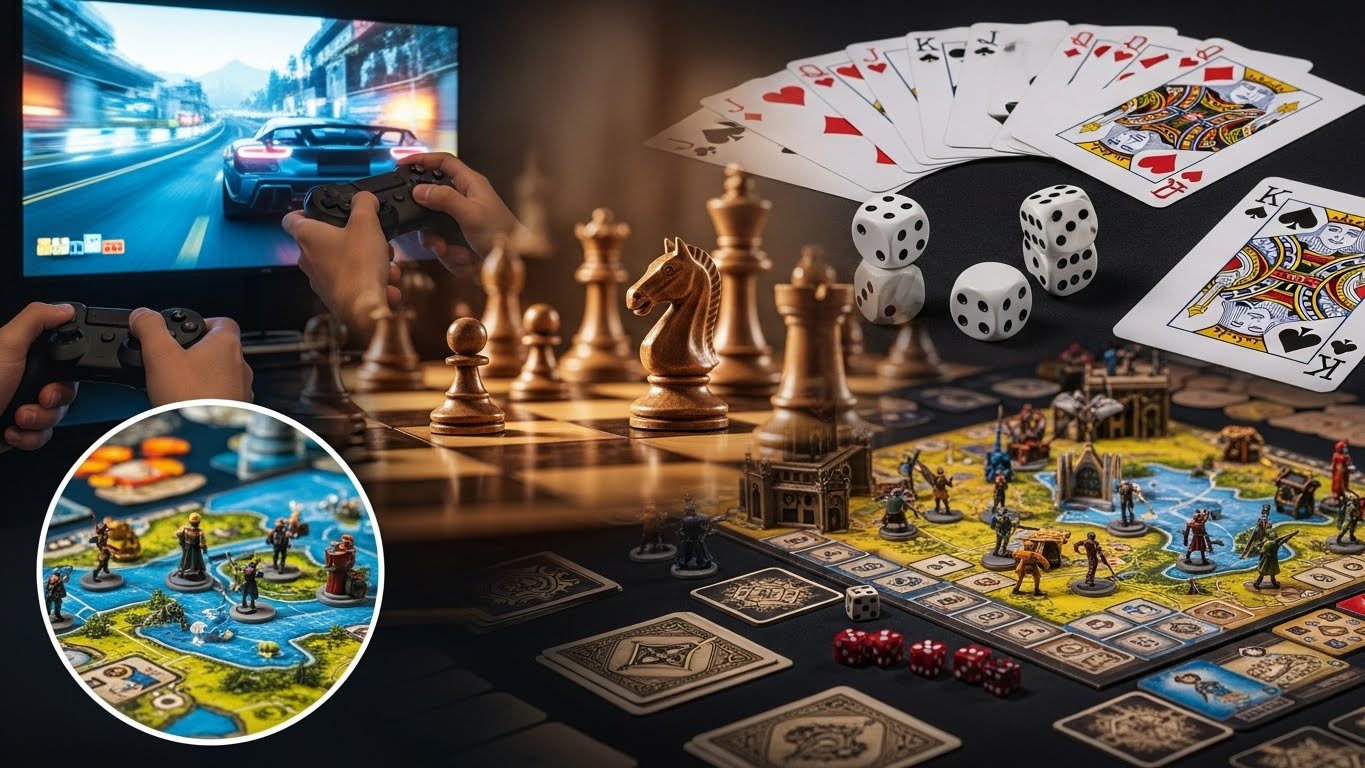

The world of games, whether digital or physical, has captivated human imagination for centuries. Games are not just pastimes; they are an integral part of our culture, society, and even our very identity. From the ancient board games played in royal courts to the high-tech, immersive virtual worlds of today, the evolution of games is nothing short of fascinating. This blog post explores the journey of games, their impact on society, the various types of games that have emerged, and where the future of gaming might be headed.
The Origins of Games: Ancient Entertainment
The history of games stretches back thousands of years, and it’s clear that games have always served more than just a recreational purpose. Some of the earliest forms of games were board games like Senet from ancient Egypt, Go from China, and backgammon from Mesopotamia. These games weren’t just meant for entertainment; they often carried symbolic meanings, representing life, death, strategy, or even spiritual growth.
Games like Senet were played in royal courts, often with intricate rules, representing the journey of the soul. In contrast, Go is a strategy game that originated in China more than 2,500 years ago and is still widely popular today. It has been described as one of the most complex games in the world, with an estimated number of possible game combinations greater than the number of atoms in the observable universe. Games have always been about more than just the rules; they reflect culture, intelligence, and the very fabric of human connection.
Even physical games, like early forms of soccer and wrestling, have roots in ancient civilizations, where games and sports were used to train warriors or celebrate victories. These early forms of competition set the groundwork for modern gaming, both digital and physical.
The Rise of Digital Games: A New Era of Fun
The digital revolution of the late 20th century brought about the explosion of electronic games, transforming the way we play, interact, and experience entertainment. The first known video game, “Tennis for Two”, was created in 1958 by physicist William Higinbotham. It was a simple two-player game that allowed players to control paddles and hit a ball back and forth, resembling a basic version of what would later become Pong.
In 1972, Atari’s release of Pong made video games commercially viable, launching the video game industry into the mainstream. This era marked the beginning of arcade gaming, with huge machines flashing bright colors and producing pixelated graphics that captured the attention of millions. Games like Space Invaders, Pac-Man, and Asteroids dominated the arcades, offering players a fun and often competitive environment.
As technology progressed, home consoles such as the Atari 2600 and the Nintendo Entertainment System (NES) brought the excitement of arcade gaming into the living room. This development revolutionized gaming by allowing people to enjoy high-quality video games at home. The 1980s and 1990s are often considered the golden age of gaming, with the release of iconic titles like Super Mario Bros., The Legend of Zelda, and Final Fantasy that have since become cultural touchstones.
The Age of 3D Graphics and Immersive Worlds
The late 1990s and early 2000s brought about significant technological advancements that introduced 3D graphics into gaming. The arrival of the Sony PlayStation in 1994, followed by the Nintendo 64 in 1996, signaled a new era in gaming. These consoles introduced players to 3D worlds, allowing for more complex game mechanics, immersive environments, and deeper storytelling.
The release of Super Mario 64 in 1996 is often cited as one of the greatest breakthroughs in video game design. It was one of the first fully realized 3D platformers, offering a vast, open world for players to explore. Mario’s new ability to move freely in a 3D space transformed the way we thought about game design, and it influenced countless games that followed.
As technology continued to evolve, game developers were able to create even more intricate and detailed worlds. The Grand Theft Auto series, The Elder Scrolls V: Skyrim, and Halo all helped define the modern gaming experience by offering expansive, open-world environments and complex storylines. These games immersed players in vast universes where they could explore, make choices, and live out adventures on their own terms.
Online Gaming: Connecting the World
The advent of the internet in the late 1990s and early 2000s transformed gaming in ways that few could have anticipated. Online gaming allowed players to connect with others around the world, leading to the creation of massive multiplayer online games (MMOs). World of Warcraft, released in 2004, became one of the most influential and successful MMOs of all time, attracting millions of players who could socialize, raid dungeons, and engage in epic battles together.
Online gaming also gave rise to competitive gaming and eSports—a global phenomenon where players compete at the highest levels for cash prizes and sponsorships. Games like League of Legends, Dota 2, and Counter-Strike have become staples of the eSports scene, with professional tournaments attracting massive audiences both online and in person. Today, competitive gaming has become a career for some, with sponsorships, streaming deals, and even college scholarships dedicated to those who excel in digital sports.
In addition to MMOs and eSports, online gaming opened up new opportunities for casual gamers. Games like Fortnite, Minecraft, and Among Us have become global phenomena, allowing players to come together to enjoy fun, social experiences without the need for intense commitment or deep strategy.
Mobile Gaming: A Revolution in the Palm of Your Hand
As smartphones became ubiquitous in the 2010s, mobile gaming emerged as one of the fastest-growing sectors in the gaming industry. Mobile games are uniquely accessible, offering players a quick escape from the stresses of daily life, often through simple mechanics and addictive gameplay loops.
The success of games like Angry Birds, Candy Crush Saga, and Pokémon GO proved that gaming didn’t need to be complicated or graphically intense to be enjoyable. Mobile games are easy to pick up and play, and their convenience has made them accessible to people who may not identify as hardcore gamers. Pokémon GO, in particular, blended the digital and physical worlds by utilizing augmented reality (AR) technology, allowing players to catch Pokémon in the real world using their smartphones.
Mobile gaming also brought about the rise of free-to-play games, which rely on in-app purchases and microtransactions rather than upfront costs. This model has been incredibly successful, allowing developers to reach a wide audience while offering players the option to pay for cosmetic items, power-ups, or premium content. While this model has been controversial at times, it has nonetheless reshaped the economic landscape of gaming.
The Impact of Virtual and Augmented Reality
As virtual reality (VR) and augmented reality (AR) technologies continue to improve, gaming is on the cusp of another major transformation. VR, in particular, offers players a fully immersive experience that places them inside the game world. Devices like the Oculus Rift, HTC Vive, and PlayStation VR allow players to explore virtual environments and interact with objects and characters in a way that was previously unimaginable.
VR has the potential to revolutionize gaming by making it more immersive, interactive, and physically engaging. Games like Beat Saber and Half-Life: Alyx showcase the possibilities of VR, offering players intense, action-packed experiences that make them feel as if they are truly part of the virtual world.
AR, on the other hand, enhances the real world by overlaying digital content onto it. Pokémon GO was one of the first major successes of AR gaming, and we can expect to see more AR games in the future that merge the physical and digital worlds in exciting new ways.
The Future of Gaming: What’s Next?
As technology continues to evolve, so too does the world of gaming. The future of gaming is set to be shaped by innovations in artificial intelligence (AI), cloud gaming, and immersive experiences. AI could enable games to adapt to a player’s skill level, making the experience more challenging or relaxing based on individual preferences. Games could also become more personalized, with procedurally generated content that ensures no two playthroughs are exactly the same.
Cloud gaming, which allows players to stream games without the need for powerful hardware, is another trend that could shape the future of gaming. Services like Google Stadia, NVIDIA GeForce Now, and Xbox Cloud Gaming are already providing players with access to high-quality games on a wide range of devices, from smartphones to low-end PCs. As internet speeds improve and latency decreases, cloud gaming could become the norm, making it easier for people to enjoy high-end gaming without the need for expensive consoles or gaming PCs.
Another exciting possibility for the future of gaming lies in the potential of the metaverse—a shared virtual world where people can interact, socialize, work, and play together. The metaverse is still in its infancy, but companies like Meta (formerly Facebook) are pouring billions of dollars into creating a fully immersive digital universe. In the metaverse, gaming could be just one aspect of a larger, interconnected experience that combines social interaction, entertainment, and even commerce.
Conclusion: Gaming as a Universal Experience
Games have come a long way from their humble beginnings, evolving into a multifaceted form of entertainment that spans multiple mediums and platforms. Whether it’s the thrill of a competitive eSports match, the joy of a casual mobile game, or the immersive experience of a virtual reality world, games have something to offer everyone.