Introduction
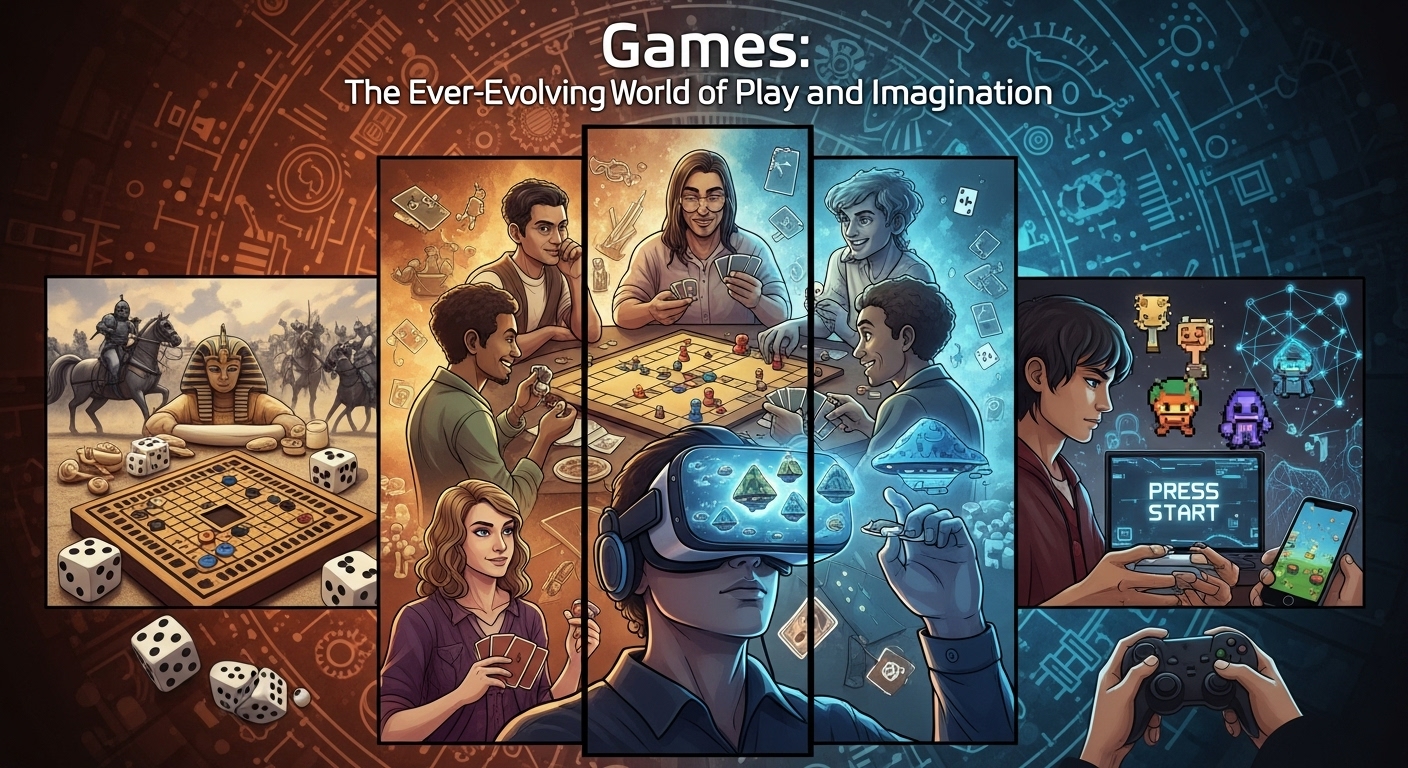
Games have always been more than just entertainment. They are a reflection of human creativity, intelligence, and the desire to explore new worlds beyond reality. From ancient times when people played simple physical or board games to the modern digital age where video games dominate global entertainment, the concept of games has evolved in remarkable ways. Games shape culture, strengthen communities, improve cognitive abilities, and provide an escape from the stresses of daily life. They are no longer confined to being a mere pastime; they have become a lifestyle, a career, and a global phenomenon that connects millions of people every day.
The Origins of Games
The history of games goes back thousands of years. Archaeological evidence shows that people in ancient civilizations played various types of games for recreation, training, and even spiritual purposes. The oldest known board game, Senet, dates back to ancient Egypt, and it was not only a form of amusement but also believed to have religious significance. The ancient Greeks and Romans played games to test physical strength and strategy, laying the foundation for competitive sports. Chess, which originated in India as Chaturanga, became a symbol of intelligence and tactical mastery in medieval Europe.
These early forms of games show that humans have always sought ways to challenge their minds and bodies. Over centuries, games evolved with societies, reflecting their values, cultures, and technologies. What began as simple pastimes gradually became organized competitions and later transformed into digital experiences.
The Transformation into Digital Entertainment
The invention of computers and electronic devices in the 20th century changed everything. The first video games, created in the 1950s and 60s, were simple and experimental, like Tennis for Two or Spacewar!. These early innovations paved the way for arcade games in the 1970s, which marked a turning point in entertainment history.
Games like Pong, Pac-Man, and Space Invaders became household names and introduced millions of people to electronic gaming. The arrival of home consoles such as the Atari 2600 brought gaming into living rooms around the world. What was once seen as a niche hobby quickly became a mainstream activity enjoyed by all age groups.
The 1980s and 1990s were the golden age of gaming. Companies like Nintendo and Sega revolutionized the industry by introducing iconic characters such as Mario, Sonic, and Link. These mascots became symbols of gaming culture and inspired generations of players. During this era, the foundations of game design, storytelling, and player interaction were firmly established.
The Rise of 3D Worlds and Immersive Experiences
The late 1990s and early 2000s saw the birth of 3D graphics, changing the way games looked and felt forever. Titles like Super Mario 64, Tomb Raider, and The Legend of Zelda: Ocarina of Time offered players vast, interactive worlds to explore. The advancement of computer graphics, sound design, and processing power made it possible to create immersive environments that felt alive.
This period also introduced new genres. Role-playing games (RPGs), first-person shooters (FPS), and open-world adventures began to dominate the industry. Games like Final Fantasy, Halo, and Grand Theft Auto set new standards for storytelling, gameplay mechanics, and realism. Players were no longer just participants; they became part of evolving narratives and virtual worlds that responded to their choices.
The Era of Online Multiplayer and Global Communities
With the rise of the internet, gaming became a social experience. Online multiplayer games connected players from different continents, allowing them to compete, cooperate, and communicate in real time. Titles like Counter-Strike, World of Warcraft, and Call of Duty defined this new age of global gaming.
Online gaming communities grew rapidly, giving rise to new cultures, friendships, and even rivalries. Voice chat and forums allowed players to form teams, guilds, and clans. Esports, or competitive gaming, emerged as a new industry where players competed professionally for fame and fortune. Games like Dota 2, League of Legends, and Fortnite transformed gaming into a global spectator sport watched by millions.
The sense of belonging and teamwork created by online games made them more than just entertainment. They became virtual societies with their own rules, traditions, and heroes.
Mobile Gaming and Accessibility
The introduction of smartphones changed gaming once again. Mobile gaming opened the door for casual players who had never owned consoles or PCs. Titles like Angry Birds, Clash of Clans, and Candy Crush became cultural sensations, proving that games could be both simple and deeply engaging.
Mobile games also made gaming more inclusive. People of all ages and backgrounds could now play anytime, anywhere. This accessibility contributed to the massive growth of the gaming industry, making it one of the most profitable entertainment sectors in the world. Developers began focusing on intuitive gameplay, touch controls, and short but addictive experiences.
Today, mobile gaming continues to evolve with advanced graphics, online connectivity, and even augmented reality. Games like Pokémon GO blurred the lines between real and virtual worlds, encouraging players to explore their surroundings in new ways.
The Role of Storytelling in Modern Games
In modern times, storytelling has become one of the most powerful elements of gaming. Players no longer just want to win; they want to feel, experience, and connect with the story. Games now rival movies and books in emotional depth and complexity.
Narrative-driven titles such as The Last of Us, Red Dead Redemption 2, and God of War show how games can convey profound human emotions like loss, hope, and redemption. The interactive nature of gaming allows players to shape the outcome of stories, making them feel responsible for their characters’ journeys.
This emotional engagement has elevated gaming into an art form. Soundtracks, visual design, dialogue, and world-building all combine to create experiences that resonate deeply with players. For many, these virtual stories are as memorable as any film or novel.
The Educational and Cognitive Value of Games
Beyond entertainment, games offer significant educational and cognitive benefits. Studies have shown that strategic and puzzle games improve problem-solving skills, memory, and attention. Simulation and management games like The Sims or Civilization teach planning, resource management, and decision-making.
Educational games are increasingly used in schools to make learning interactive and fun. Students can explore history, science, or mathematics through engaging simulations. Games also enhance creativity, encouraging players to think outside the box.
Moreover, certain types of games have therapeutic value. They help people manage stress, develop hand-eye coordination, and even aid in rehabilitation. Virtual reality games are being used in medical treatments to improve mobility and mental health. The positive potential of gaming extends far beyond entertainment.
The Dark Side of Gaming
While games have countless benefits, they also come with challenges. Excessive gaming can lead to addiction, especially among younger players. Spending too much time in virtual worlds can affect physical health, sleep patterns, and social interactions.
Online toxicity is another concern. Competitive environments sometimes lead to harassment, bullying, or exclusion. Developers and communities are working hard to promote healthy and respectful gaming spaces, but it remains an ongoing issue.
Microtransactions and pay-to-win models have also been criticized for exploiting players, especially in mobile and online games. The balance between fun and fairness is essential for maintaining the integrity of gaming culture.
The Future of Gaming
The future of gaming is incredibly exciting. With technologies like virtual reality (VR), augmented reality (AR), and artificial intelligence (AI), the boundaries of gaming are expanding faster than ever.
VR headsets now allow players to step into fully immersive environments where they can interact naturally using motion controls. AR integrates games into real-world spaces, making every environment a potential playground. AI is making games smarter, adapting challenges to each player’s style and improving storytelling through dynamic interactions.
Cloud gaming is another revolution. It allows people to stream games directly to their devices without needing powerful hardware. This makes high-quality gaming more accessible than ever before.
The future will also see deeper connections between gaming and other industries. Music, film, and fashion are already collaborating with game developers to create interactive experiences that cross traditional boundaries. As virtual worlds become more sophisticated, they may even play a role in education, work, and social interaction.
Games as a Cultural Force
Games are now a central part of modern culture. They influence music, art, movies, and even language. Phrases from games become memes, characters become icons, and gaming events attract massive audiences.
The sense of community in gaming culture is unmatched. From fan art and cosplay to streaming and esports tournaments, players express their love for games in countless creative ways. Platforms where players share gameplay and stories have created a global dialogue around the joy of gaming.
Gaming is also a force for inclusion and diversity. Developers are creating characters and stories that represent different backgrounds, genders, and cultures. This helps players feel seen and valued, reinforcing the idea that gaming truly belongs to everyone.
The Emotional Connection Between Players and Games
Perhaps the most fascinating aspect of games is their ability to create emotional bonds. Players form attachments not just to stories and characters, but also to memories shared with friends and communities. The sense of achievement after completing a difficult challenge, the joy of winning a match with teammates, or the nostalgia of playing a childhood favorite—all of these experiences form lasting impressions.
Games are unique because they allow people to live out dreams and explore possibilities that would be impossible in real life. Whether flying through space, building empires, or simply tending a virtual farm, every game gives players a chance to experience something extraordinary.
The Balance Between Fun and Responsibility
As games become more immersive and influential, both developers and players carry responsibility. Developers must ensure that games are inclusive, ethical, and designed to enhance rather than exploit players’ time. Players, on the other hand, should maintain a healthy balance between gaming and other aspects of life.
Parents and educators can play a crucial role in guiding younger players, helping them enjoy games responsibly. The future of gaming depends not only on technology but also on the values and ethics we bring to it.
Conclusion
Games have come a long way from the simple amusements of ancient civilizations to the complex virtual worlds of today. They are a blend of art, science, and emotion—an evolving medium that continues to push the limits of imagination.
Through games, people connect, learn, compete, and express themselves. They teach us teamwork, patience, and creativity. Whether played for fun, education, or profession, games have a unique power to unite people across all boundaries.
In the end, the world of games reflects who we are as humans: curious, creative, and constantly striving for new experiences. The future of gaming will continue to shape our lives, inspire our minds, and remind us that play is an essential part of being alive.